

WHAT IS A DOMAIN NAME?

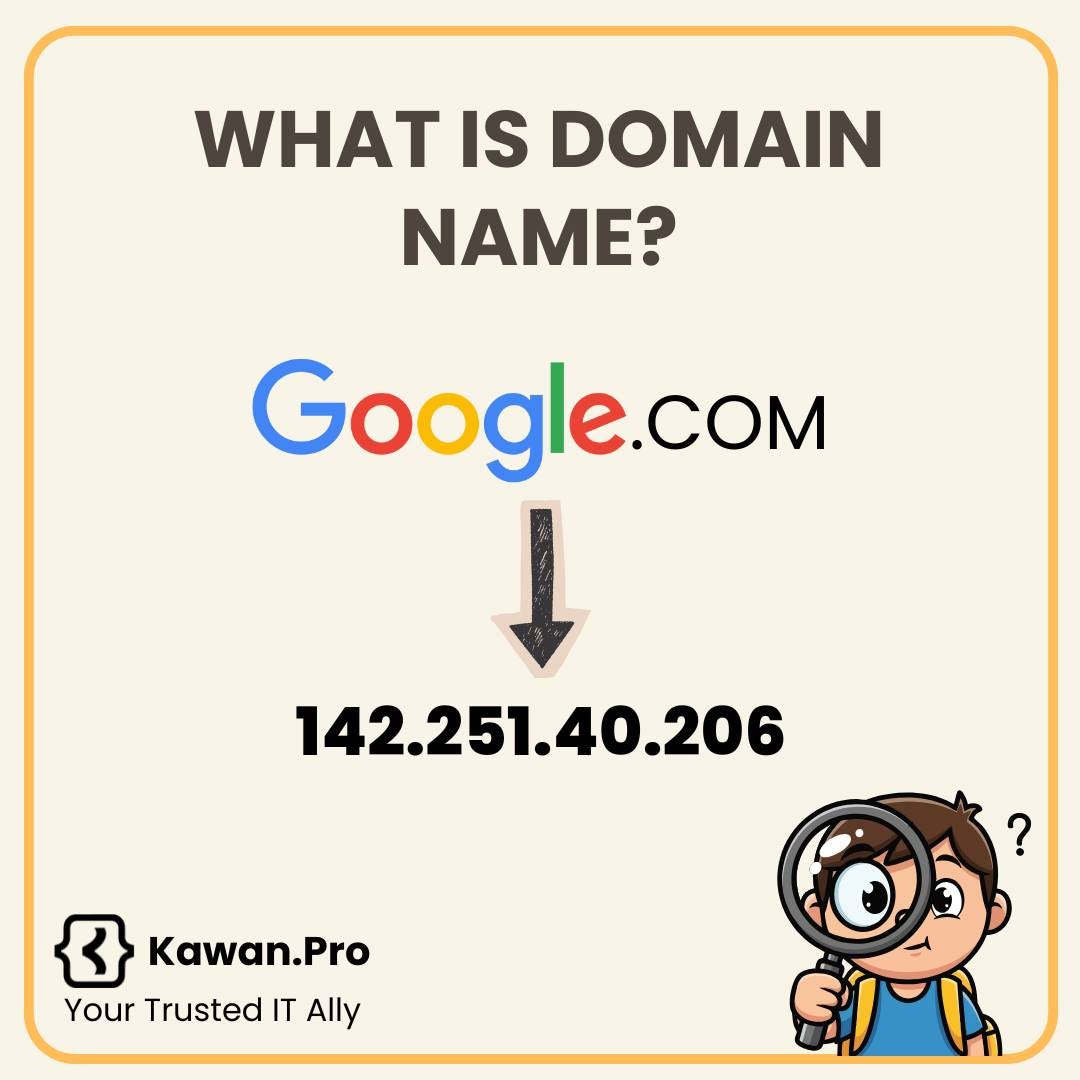
A Domain Name is a human-readable address used to identify and access resources on the internet or within a network.
Instead of remembering IP addresses like 192.168.1.10 or 142.250.190.14, we use domain names like example.com or intranet.company.local.
A domain name acts as a friendly name that maps to an IP address, making systems and services easier to access and manage.
So, Domain Name = human-friendly name → IP address
KEY FUNCTIONS OF A DOMAIN NAME
1) Easy System Identification
Provides a simple and memorable name for websites, servers, and services.
2) Name-to-IP Resolution
Works with DNS Resolver to translate domain names into IP addresses that computers understand.
3) Organizational Structure
Helps structure systems logically (e.g. hr.company.com, mail.company.com).
4) Service Accessibility
Used to access websites, email servers, applications, and internal systems.
5) Branding & Identity
Represents an organization’s identity on the internet or within internal networks.
WHY IS A DOMAIN NAME IMPORTANT?
✔️ Eliminates the need to remember IP addresses
✔️ Makes systems easier to access and manage
✔️ Enables DNS-based services (web, email, apps)
✔️ Supports scalability and structured naming
✔️ Essential for both internet and enterprise networks
Without domain names, accessing systems would be confusing, error-prone, and inefficient.
COMMON DOMAIN NAME COMPONENTS
Top-Level Domain (TLD) – .com, .org, .net, .local
Second-Level Domain – company in company.com
Subdomain – mail.company.com, vpn.company.com
DNS Records – A, AAAA, CNAME, MX, TXT
Fully Qualified Domain Name (FQDN) – complete domain path
FOUND THIS HELPFUL?
👍 Like if you learned something new
🔁 Share to help others understand IT fundamentals
🔔 Follow for more simple IT & infrastructure explainers