

HOW VLAN WORKS?

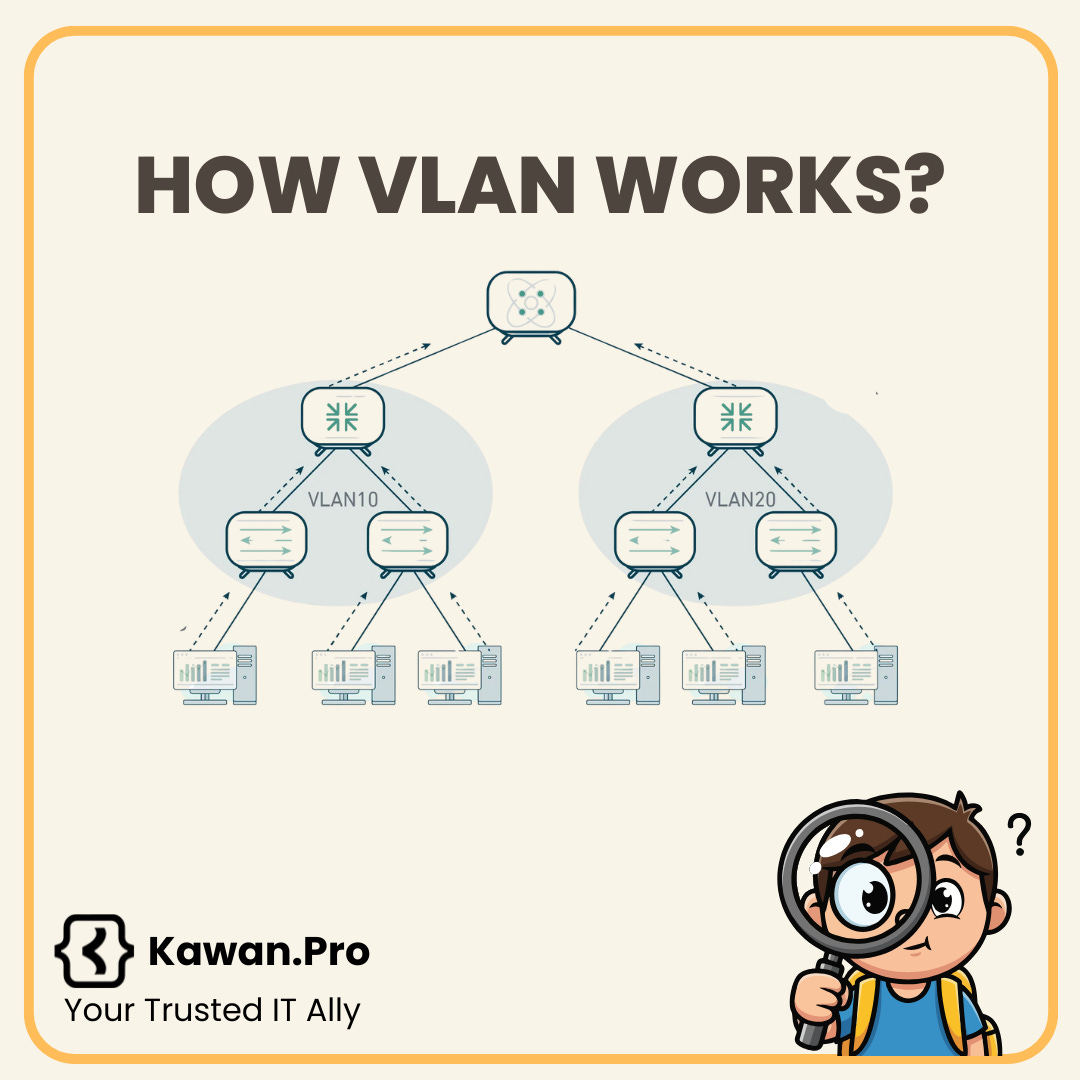
A VLAN (Virtual Local Area Network) is a way to logically divide a physical network into multiple isolated networks.
Even if devices are connected to the same switch, VLANs make them behave as if they are on separate networks.
Simply put: VLAN separates traffic without needing separate hardware.
KEY USES OF VLAN
1. Network segmentation
Separates users, servers, guests, or departments into different networks.
2. Improved security
Limits who can access what (e.g. Staff VLAN vs Guest Wi-Fi VLAN).
3. Reduced broadcast traffic
Broadcasts stay within the same VLAN → better performance.
4. Better network management
Easier to organize devices by role, not by physical location.
5. Scalability
Add new devices or departments without rewiring the network.
COMMON VLAN EXAMPLES
VLAN 10 – Staff / Office Users
VLAN 20 – Servers
VLAN 30 – CCTV / IoT
VLAN 40 – Guest Wi-Fi
VLAN 99 – Network Management
Each VLAN is isolated unless routing (Layer 3) is explicitly allowed.
WHY IS VLAN IMPORTANT?
✔ Improves network security
✔ Reduces network congestion
✔ Makes troubleshooting easier
✔ Enables professional network design
✔ Essential for business & enterprise networks
Without VLAN, every device talks to everyone. With VLAN, only the right devices talk to each other.
FOUND THIS HELPFUL?
👍 Like if you learned something new
🔁 Share to help others understand networking
🔔 Follow for more simple IT & networking explainers
--
Subscribe to our newsletter so you don’t miss our informative insights!
Visit

and subscribe today 🚀